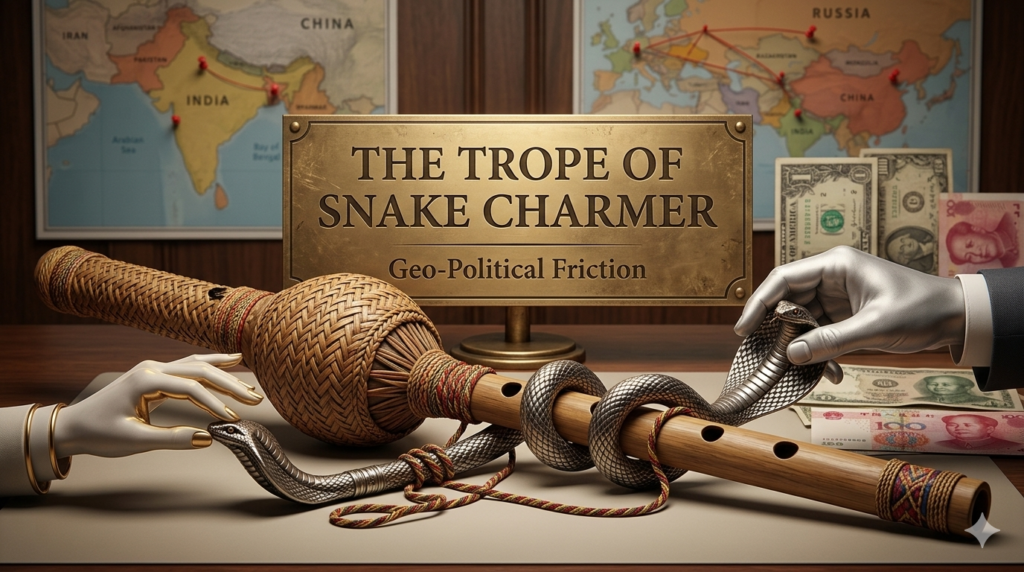

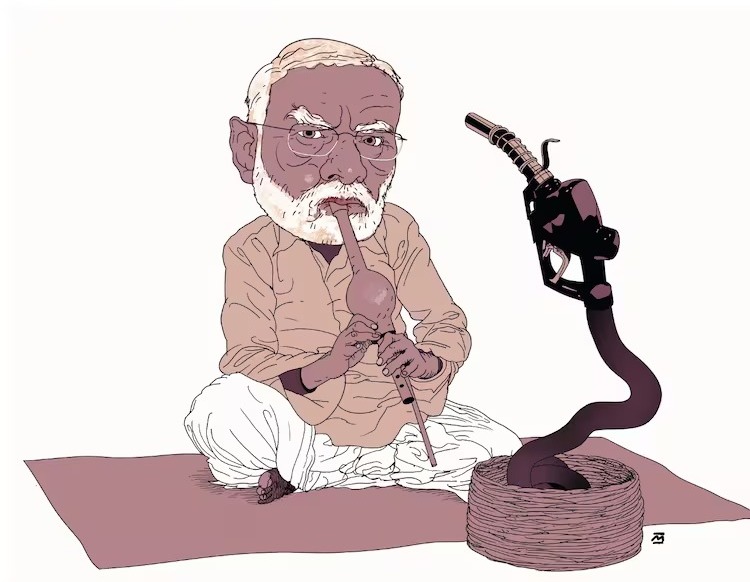
This May 2026, a diplomatic milestone meant to celebrate the forward-looking “Green Strategic Partnership” between India and Norway was suddenly overshadowed by an intense geopolitical and cultural flashpoint online. During Indian Prime Minister Narendra Modi’s official state visit to Oslo—the first by an Indian Prime Minister in over four decades—Norway’s leading daily newspaper, Aftenposten, published a highly controversial political cartoon. Illustrated by Marvin Halleraker, the piece depicted PM Modi as a “snake charmer” controlling a slithering fuel-pump hose, accompanied by a sharply titled op-ed, “A Clever and Slightly Annoying Man”. What was intended by the European publication as a satirical critique of India’s independent foreign policy and energy imports instantly transformed into a global social media storm. The incident laid bare a deep civilisational friction point, exposing the persistent undercurrent of colonial-era tropes in Western media, while triggering a fierce digital counter-troll campaign by modern global netizens.
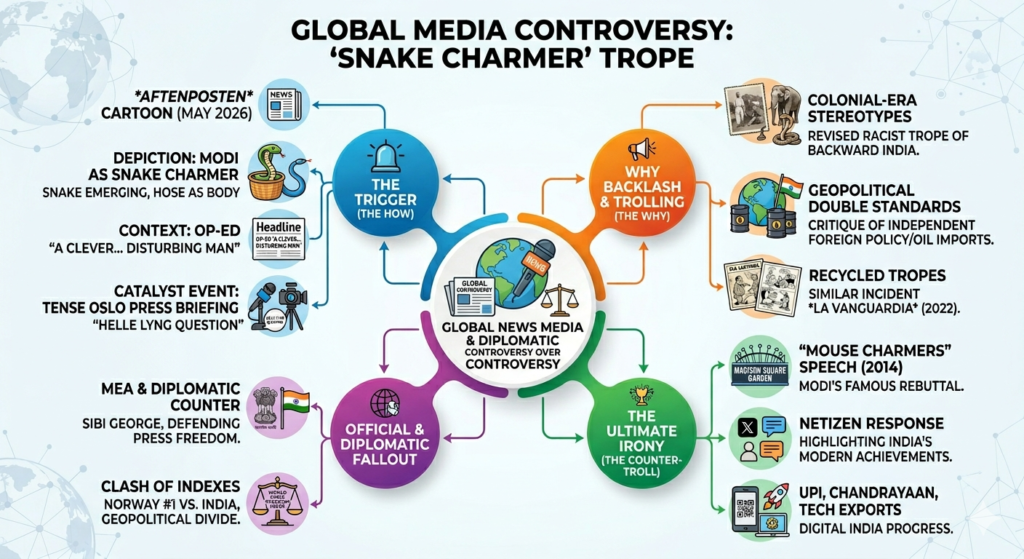
To understand how the controversy erupted, one must examine the chain of events in Oslo. The atmosphere grew tense following a press briefing where Norwegian journalist Helle Lyng vocally questioned PM Modi regarding India’s press freedom, asking why he routinely avoids direct, unscripted media queries. The heated exchange went viral online, framing the visit not just around trade and environmental pacts, but around conflicting Western and Eastern definitions of democratic accountability.
Against this backdrop of journalistic friction, Aftenposten released its cartoon. By substituting a traditional snake with a fuel-station pump hose, the illustrator attempted to comment on India’s calculated manoeuvres in global energy markets—specifically its ongoing imports of Russian oil amid Western sanctions. However, the choice of imagery immediately backfired. Rather than engaging with the nuance of India’s strategic autonomy or energy security, the cartoon took a visual shortcut. It relied on a highly charged, archaic caricature that reduced a rising digital and nuclear superpower to a century-old Orientalist cliché.
The immediate and overwhelming outrage from the Indian diaspora and global commentators centered on the explicitly racist history of the “snake charmer” trope. During the 19th and early 20th centuries, British and European colonial powers systematically used depictions of snake charmers, fakirs, and elephants to portray the Indian subcontinent as an exotic, primitive, and backward civilisation. This imagery served a specific political purpose: it justified the “civilising mission” of Western imperialism by implying that India was too uneducated and superstitious to govern itself. When a major European newspaper revived this exact visual framework in 2026, critics argued it proved that sections of the Western commentariat remain trapped in a patronising, neo-colonial mindset. The backlash highlighted a blatant double standard in global media: while Western leaders are lampooned for their specific policies, non-Western leaders are frequently reduced to reductive racial or cultural stereotypes.
Furthermore, netizens pointed out that this was a recycled habit. In 2022, the Spanish newspaper La Vanguardia faced similar fury for using a snake charmer graphic to illustrate India’s economic growth. The repetition of this imagery demonstrated an inability or unwillingness within European newsrooms to conceptualize Indian progress outside of colonial frameworks. The most fascinating aspect of the controversy was how social media users, particularly on X (formerly Twitter), weaponised the insult to mount a massive counter-troll campaign. Rather than merely playing the victim, digital commentators flipped the narrative by highlighting the profound irony of the stereotype in 2026. This pushback directly channelled a famous, decade-old rebuttal delivered by PM Modi himself. Speaking to the Indian diaspora at Madison Square Garden in New York in 2014, Modi had famously noted the following:
“Our country was once known as the land of snake charmers. Today, our IT youth have forced the world to change its mindset; now our youth are ‘mouse charmers’—they move a computer mouse, and the world moves.”
Netizens flooded Aftenposten’s comment sections and editorial tags with a deluge of real-world data, contrasting the “primitive” cartoon with India’s current realities. Users pointed out that the country being depicted as a land of snake charmers is concurrently leading the world in real-time digital payments via the Unified Payments Interface (UPI), launching successful lunar and Mars missions through ISRO, and serving as the back-office and tech-export engine of the global economy. The juxtaposition made the Norwegian publication look fundamentally out of touch, transforming the intended insult into a demonstration of Western media’s growing obsolescence in understanding the global South.
Beyond the digital warfare of memes and hashtags, the incident carried significant diplomatic and structural weight. The Ministry of External Affairs (MEA) and Indian diplomats, including Secretary (West) Sibi George, actively stepped in to counter the narrative during subsequent press briefings. Defending the robustness of India’s multi-lingual and vast domestic media landscape, Indian officials pushed back against what they viewed as an aggressive, pre-formulated European narrative on press freedom.
The dispute brought to the forefront a structural “clash of indexes”. Norway regularly secures the #1 spot on the World Press Freedom Index, using its position to project global moral authority on human rights and speech. India, conversely, has long criticised these Western-centric indexes for their flawed, non-transparent methodologies that fail to capture the sheer scale and complexity of non-Western democracies. The cartoon controversy became a microcosm of this macro-level geopolitical divide: a wealthy Nordic nation lecturing the world from a position of perceived moral superiority, met by a fiercely defensive, rising global power that refuses to be viewed through an outdated imperial lens.
| Western Media Narrative (Aftenposten) | Global Indian Netizen Rebuttal |
| Visual Trope: Backward India as a “Snake Charmer”. | Modern Reality: Digital superpower driven by “Mouse Charmers.” |
| Geopolitical Stance: India’s oil imports are “cunning” and “annoying”. | Geopolitical Stance: Strategic autonomy prioritizing national energy security. |
| Moral Framework: Championing Western-centric press freedom standards. | Moral Framework: Rejecting selective colonial arrogance and racial caricatures. |
The 2026 Aftenposten cartoon controversy was never just about a single drawing or a fleeting internet trend; it was a symptom of a shifting global order. It demonstrated that while economic and technological power has rapidly decentralised toward Asia, institutional cultural mindsets in Western Europe have lagged behind. By trying to troll a foreign leader using a racist, archaic stereotype, the publication inadvertently shone a mirror back on its own biases. The fierce digital backlash proved that modern India possesses not just the economic clout to negotiate on its own terms but also a digitally savvy global population ready to dismantle colonial narratives in real-time.