
The health of a democracy, in political philosophy, it is traditionally measured by its institutions: the independence of its judiciary, the vibrancy of its press, and the integrity of its electoral systems. However, in the digital age, a democracy’s vitality is increasingly defined by the agility and creativity of its counterculture. In mid-May 2026, Indian politics witnessed one of its most unusual, rapid, and significant counter-cultural phenomena with the sudden emergence of the Cockroach Janta Party (CJP). Visit their website: https://cockroachjantaparty.org/#manifesto
What began as an immediate, visceral reaction to a derogatory comment from the highest echelons of the judiciary quickly transformed into a nationwide digital movement. Drawing hundreds of thousands of official online registrations and capturing the imagination of a heavily online Gen-Z demographic, the CJP bridged the gap between absurd internet humor and concrete constitutional reform. By transforming a symbol of filth and disgust—the cockroach—into a badge of resilience and democratic defiance, the movement has re-written the playbook for youth mobilization and political communication in modern India.
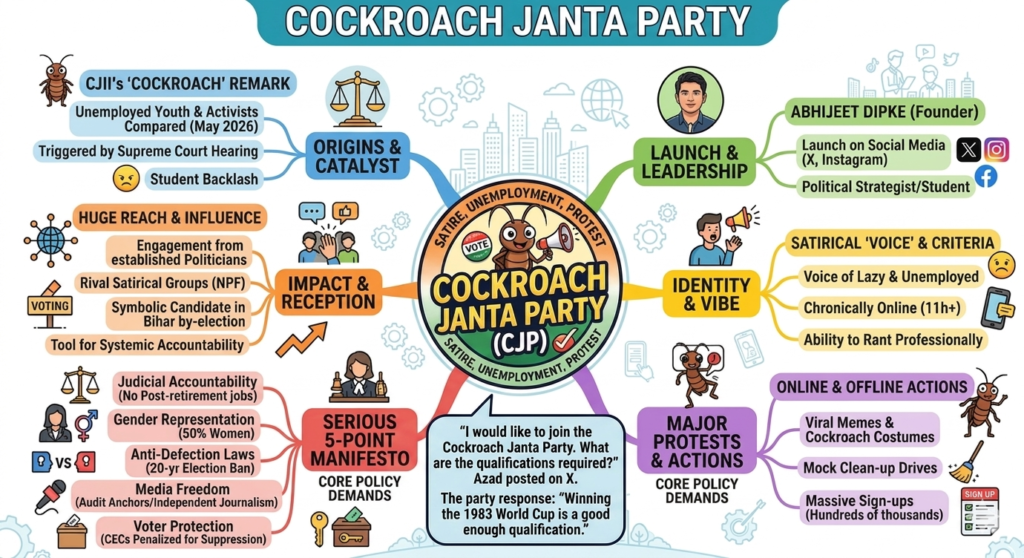
To understand the explosive rise of the Cockroach Janta Party, one must examine the specific institutional friction that triggered it. On May 15, 2026, during a Supreme Court hearing addressing the systemic proliferation of fake law degrees, Chief Justice of India (CJI) Surya Kant expressed deep frustration regarding the misuse of legal platforms, media spaces, and Right to Information (RTI) mechanisms. In doing so, the CJI made a sweeping analogy that resonated far beyond the courtroom walls:
“There are youngsters like cockroaches wh don’t get any employment or have any place in the profession. Some of them become media, some of them become social media, RTI activists and other activists and they start attacking everyone.”
The comparison of unemployed youth and independent watchdogs to “cockroaches”—pests traditionally associated with decay, disease, and unwanted intrusion—struck an immediate nerve. The comment arrived against a backdrop of deep socio-economic anxiety. For years, India’s educated youth had been grappling with high structural unemployment, underemployment, and an increasingly competitive job market plagued by paper leaks, canceled examinations, and bureaucratic delays in public sector hiring.
For many young citizens, the remark felt like a betrayal by an elite establishment that was fundamentally disconnected from the ground realities of the demographic dividend. Rather than viewing unemployment as a systemic failure of policy and governance, the statement appeared to pathologize the unemployed, characterizing their digital presence and civic activism as malicious, parasitic behavior. The structural anger was palpable, but instead of manifesting as traditional, localized street protests, it found an outlet in the hyper-accelerated laboratory of Indian social media.
Within twenty-four hours of the Supreme Court hearing, Abhijeet Dipke, a 30-year-old political communications strategist and student, executed a masterclass in political judo. Rather than launching a conventional campaign of condemnation, Dipke co-opted the insult. On May 16, 2026, he officially announced the creation of the Cockroach Janta Party (CJP) across X (formerly Twitter) and Instagram. The underlying logic was simple yet brilliant: if the ruling elite viewed ordinary, struggling citizens as cockroaches, then the citizens would proudly claim that identity. Dipke noted with biting irony that cockroaches do not create filth; they merely breed where filth and rot already exist. Therefore, the presence of millions of political “cockroaches” was a direct indicator of structural decay within the Indian political and institutional framework.
The movement immediately went viral. It offered an outlet for a generation that felt ignored by mainstream political narratives. By using dark humor, self-deprecation, and absurdism, the CJP bypassed the standard, highly polarized channels of Indian political discourse. It was neither strictly aligned with the traditional opposition nor defensive of the ruling coalition; it was an autonomous entity born out of pure generational frustration. The Cockroach Janta Party successfully cultivated a distinct aesthetic and ideological stance, positioning itself as the anti-establishment alternative. It formally declared its ideology to be “Secular, Socialist, Democratic, and Lazy.” The inclusion of “lazy” was a deliberate, satirical subversion of the capitalist and nationalist demands for constant, uncomplaining productivity from a youth population that lacks adequate structural opportunities.
The party’s official platform listed a set of humorous, highly relatable criteria for membership, designed to appeal directly to the “chronically online” demographic:
- Unemployment Status: An applicant had to be unemployed “by choice, by force, or by principle.” This status directly mocked the lack of formal job creation.
- The Dimension of Laziness: The party clarified that laziness referred strictly to physical activity, carving out space for intense, hyper-active mental and digital engagement.
- Chronically Online Presence: Members were required to spend at least 11 hours daily on social media, including bathroom breaks, emphasizing the digital-first nature of modern citizenship.
- Professional Ranting: An ability to “rant professionally” was mandatory. The content of the rants had to be sharp, honest, and pointed directly at systemic issues.
The party’s operations are defined by its rapid, sharp-witted engagement with public figures. A prime example of this occurred on May 20, 2026, when a prominent user named Azad posted an inquiry on X:
“I would like to join the Cockroach Janta Party. What are the qualifications required?”
The CJP’s official handle delivered a swift, viral response:
“Winning the 1983 World Cup is a good enough qualification.”
| Dimension | Traditional Political Parties | Cockroach Janta Party (CJP) |
| Primary Currency | Financial capital, muscle power, caste alignments | Memetic velocity, sharp wit, relatability |
| Target Audience | Broad, traditional vote banks | Chronically online youth, gig workers, students |
| Communication Style | Formal rallies, high-budget PR, rigid party lines | Absurdist humor, real-time X/Instagram call-outs |
| Symbolism | Heritage icons (Hand, Lotus, Elephant, etc.) | The resilient, indestructible Cockroach |
This interaction—reported widely by mainstream outlets like The Economic Times—highlighted the party’s unique appeal. By setting an impossibly high, historically nostalgic hurdle (referencing India’s historic cricket victory under Kapil Dev), the CJP highlighted the absurdity of traditional political meritocracies while keeping its audience engaged through shared cultural touchstones. While the CJP’s aesthetic relies heavily on internet memes and absurdist humor, its underlying structural critique is remarkably serious. The movement understands that pure satire, without a constructive alternative, quickly degenerates into cynicism. To counter this, the party released a core 5-Point Manifesto that targeted deep structural flaws within the Indian state.
Directly addressing the source of its origin, the CJP demanded a complete ban on post-retirement government assignments, corporate board memberships, or Rajya Sabha nominations for Supreme Court and High Court judges. This policy targets “judicial overreach” and the potential compromise of the separation of powers, arguing that judges who look forward to lucrative post-retirement postings from the executive branch cannot remain truly independent watchdogs of the Constitution. The manifesto calls for an immediate, mandatory 50% reservation for women across both houses of Parliament, state legislative assemblies, and cabinet positions. While traditional parties have long delayed or diluted the implementation of women’s reservation bills with various clauses and sub-clauses, the CJP placed absolute gender parity at the center of its systemic vision.
In response to the frequent collapse of state governments due to elected representatives switching parties—a phenomenon colloquially known in Indian politics as Horse-Trading or the Aaya Ram Gaya Ram culture—the CJP proposed an uncompromising penalty. Any Member of Parliament (MP) or Member of Legislative Assembly (MLA) who defects from the party under whose banner they were elected would face an immediate, 20-year ban from contesting elections or holding any public office. The manifesto takes aim at the corporate capture of mainstream television news, which has often been accused of polarizing the public and ignoring critical issues like unemployment. The CJP demands rigorous independent financial audits of high-profile, biased media anchors. Furthermore, it advocates for revoking broadcasting licenses from massive corporate conglomerates to encourage decentralized, subscriber-supported, independent journalism.
In light of recurring complaints regarding the arbitrary deletion of legitimate citizens’ names from electoral rolls, the CJP proposed that voter suppression be treated as a form of institutional terrorism. Under their policy, if systemic deletion of valid voters is proven, the Chief Election Commissioner (CEC) and responsible bureaucrats would be prosecuted under the Unlawful Activities (Prevention) Act (UAPA), ensuring maximum accountability for safeguarding the right to vote.
The Cockroach Janta Party has successfully demonstrated how a digital movement can transition into offline spaces without losing its unique, satirical identity. Within days of its launch, the movement spilled from smartphone screens onto the streets of major urban centers like Mumbai, Delhi, Bengaluru, and Pune.
Instead of traditional, angry demonstrations that often lead to clashes with law enforcement, CJP supporters organized “Mock Clean-up Drives.” Dressed in elaborate, lightweight cockroach costumes, young students and gig-economy workers gathered in public spaces, parks, and outside local municipal offices with brooms and garbage bags.
The symbolic messaging was multi-layered:
- By physically cleaning public spaces, they subverted the idea that they were “pests” or “filth.”
- They highlighted the failure of municipal bodies to maintain basic infrastructure.
- The presence of hundreds of citizens dressed as cockroaches created a highly visual, un-arrestable form of protest that local authorities struggled to suppress using conventional methods.
The movement’s rapid growth caught the attention of established political figures. Members of Parliament, such as the All India Trinamool Congress (TMC) leader Mahua Moitra, engaged with the party’s content, recognizing its potential to shift youth voter sentiment.
The digital success of the CJP also triggered the formation of copycat groups and counter-satirical movements, most notably the National Parasitic Front (NPF), which sought to mock the CJP’s focus on laziness. This imitation further validated the CJP’s role in defining the political discourse of May 2026.
By late May, discussions emerged within the CJP’s digital forums regarding crowdfunding a symbolic independent student candidate for an upcoming by-election in Bihar, testing whether a memetic movement could translate digital engagement into actual electoral data. The emergence of the Cockroach Janta Party highlights a broader transformation in how political communication operates within hyper-connected democracies. Traditional opposition parties in India often struggle to counter dominant political narratives because they rely on conventional press conferences, policy documents, and institutional critiques that can be easily minimized by mainstream media.
The CJP succeeds precisely because it operates on a different emotional plane. By utilizing weaponized self-deprecation, the party renders standard political attacks ineffective. When an opponent attempts to dismiss a CJP supporter as “unemployed”, “lazy”, or a “troll”, the critique fails because those labels are already part of the party’s core identity.
Furthermore, the cockroach is an effective political symbol due to its evolutionary biology. It is an organism famed for its ability to survive extreme conditions, radiation, and systematic attempts at extermination. For a youth population facing precarious economic conditions and an overwhelming state apparatus, the cockroach represents survival, resilience, and adaptability.
Conclusion
The Cockroach Janta Party is more than a fleeting internet trend; it represents a sophisticated evolution in contemporary political protest. By taking a dismissive comment from an institutional authority and transforming it into a structured, visual, and highly critical political movement, India’s youth have demonstrated the power of digital-first activism.
Whether the CJP eventually registers as a formal political party or remains a decentralized satirical collective, its impact on the political landscape is undeniable. It has shown that humour can be used effectively to challenge authority, that memes can convey serious policy demands, and that a generation labeled as “lazy” can mobilize rapidly when pushed. In a political environment often dominated by polarization and heavy-handed rhetoric, the Cockroach Janta Party offers a reminder that sometimes the most effective way to challenge power is simply to make it look ridiculous.