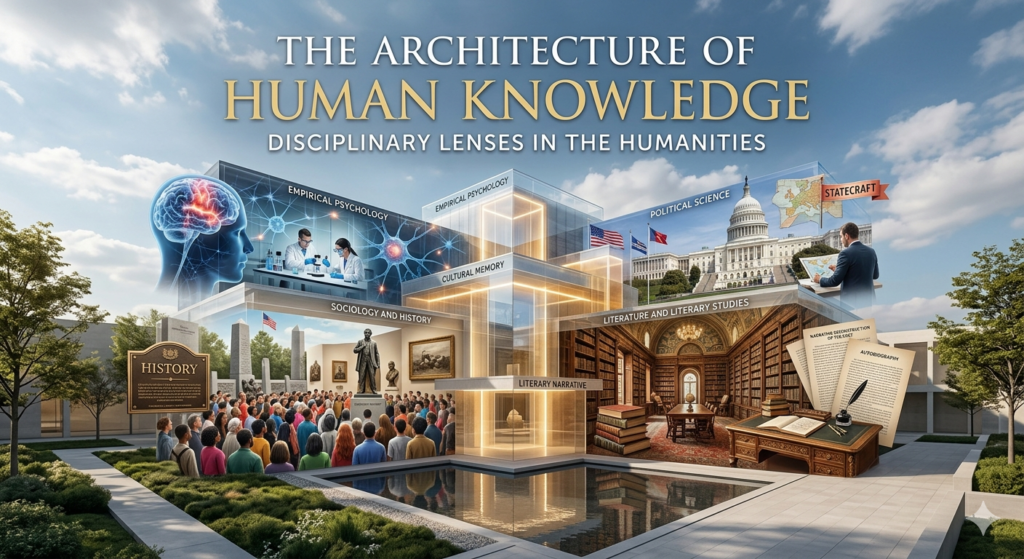

The pursuit of human knowledge is not a monolithic endeavor. Rather, it is a vast, interconnected ecosystem structured by specialized intellectual traditions. At the core of this ecosystem lie three major fields of inquiry: the Social Sciences, the Humanities, and Psychology. Together, these divisions serve as the foundational architecture through which humanity observes, interprets, and rationalizes its own existence. While technical, computational, and hard scientific advancements provide the physical tools to alter the material world, these three domains provide the indispensable critical frameworks required to ensure that human progress remains ethical, inclusive, and deeply human-centered. They do not merely teach us how to survive through technological efficiency; they teach us how to understand our nature, navigate our structures, and live a life that is meaningful and just.
The Social Sciences act as the macro-analytical engine of civilization. Utilizing systematic, empirical, and often quantitative methodologies, disciplines such as sociology, economics, and political science map out the invisible, overarching structures that govern collective human life. The primary objective of the social sciences is to identify, isolate, and analyze the mechanics of human interaction on a systemic scale. They investigate how institutions are built, how wealth is distributed, how power is brokered, and how social strata are maintained or disrupted.
The social sciences operate on the premise that human beings, when gathered in collectives, produce emergent structural realities that cannot be understood merely by examining a single individual. These structures—ranging from global supply chains and judicial systems to socio-economic classes and bureaucratic systems—exert immense gravity over daily life. When modern society faces complex, systemic crises such as urban housing shortages, systemic wealth inequality, or the disruptive labor shifts caused by automation, it is the social sciences that provide the evidence-based, data-driven diagnostic frameworks required to build effective policies and structural interventions. They translate chaotic collective behavior into scannable data, allowing states and organizations to implement systemic changes based on observable patterns rather than ideological guesswork.
If the social sciences function as an analytical engine assessing structural mechanics, the Humanities serve as the reflective heart and moral conscience of our species. The humanities focus intensely on the subjective dimension of the human experience, exploring it through the critical interrogation of history, philosophy, literature, language, and the arts. While the social sciences ask how human systems function and gather data to track those functions, the humanities ask what those systems mean and evaluate the ethical implications of their outputs.
The humanities do not solve social issues by engineering physical mechanisms or drafting legislative policies; instead, they operate upstream, shifting the underlying mindsets, value structures, and cultural narratives that drive all human behavior. The humanist recognizes that a technical solution is only as good as the moral clarity of the society deploying it. For example, while a medical scientist might develop a highly effective vaccine to combat a deadly pandemic, a humanist steps forward to analyze the historical, cultural, or philosophical factors that cause certain populations to distrust medical institutions or state authority.
At their core, the humanities address systemic challenges through these primary mechanisms:
- Ethical Scaffolding: When society enters uncharted territory—such as navigating algorithmic bias in artificial intelligence, engineering the human genome, or managing the surveillance mechanisms of modern tech monopolies—philosophers, bioethicists, and moral theorists step in. They provide the logical frameworks needed to determine what society should do, rather than simply what technology makes possible. They guard human dignity against the cold calculus of pure systemic efficiency.
- Historical Context and Empathy: Deeply entrenched social crises, from geopolitical border disputes to systemic racial polarization, cannot be solved by looking only at surface data. These tensions are manifestations of historical traumas and power asymmetries centuries in the making. Historians and literary scholars unearth these hidden narratives, compelling communities to confront their past. By engaging with the stories, languages, and artistic expressions of “the other,” the humanities erode the tribalistic “us vs. them” mentalities that fuel modern polarization, replacing them with the cultural literacy required for genuine conflict resolution and social cohesion.
- The Critique of Discourse: Linguists, rhetoricians, and critical theorists act as watchdogs over communication. In an era dominated by information warfare, deepfakes, and algorithmic echo chambers, social problems are continuously exacerbated by the manipulation of language. The humanities equip citizens with information literacy, teaching them to deconstruct political framing, spot logical fallacies, and resist emotional coercion, thereby preserving the integrity of democratic dialogue.
Bridging the empirical rigor of the social sciences and the deeply reflective, subjective depth of the humanities, Psychology turns its focus inward, isolating the internal mechanisms of human nature. Psychology defines its terrain as individual cognition, emotion, neurological processing, and behavior. While sociology looks at the overarching crowd and the humanities interpret the cultural artifacts that the crowd produces, psychology uncovers the “universal machinery” of the single human mind that populates both spheres.
Psychology utilizes controlled experimentation, neuroimaging, cognitive testing, and clinical observation to determine how the human mind perceives, processes, and reacts to internal and external stimuli. It acknowledges that human beings are not purely rational actors, nor are they completely blank slates written upon by social structures. Instead, humans are complex biological and psychological entities driven by evolutionary drives, cognitive biases, unconscious defense mechanisms, and neurochemical pathways.
In the contemporary world, psychology provides the vital analytical framework for understanding the human factor within macro systems. When an economist calculates market trends, a psychologist explains the underlying emotional contagion of fear or greed driving those trends. When a cultural studies scholar critiques the alienating effects of social media, a psychologist maps out how algorithmic notifications exploit the dopaminergic pathways of the brain, causing addiction, anxiety, and fragmented attention spans. By understanding the mind within, psychology creates a bridge showing how internal mental health directly dictates external social reality.
To navigate the vast landscape of higher learning, one must realize that an academic discipline is not merely defined by its surface-level topic, but by a precise intersection of its Methodology and its Object of Study. It is a common misconception that different fields simply look at different areas of the world—for instance, that historians look only at dusty archives while psychologists look only at patients on a couch. In reality, the boundaries between disciplines are philosophical. The very definition of what is being observed—the “object”—transforms radically depending on the academic lens through which it is viewed.
Even when multiple disciplines claim to study the exact same broad concept, they isolate entirely different variables, gather completely different types of evidence, and operate under profoundly different philosophies regarding how truth is discovered.
The Analytical Case of Memory
To fully comprehend this phenomenon, consider the multi-disciplinary treatment of Memory. “Memory” seems like a straightforward, singular concept, yet across the academic spectrum, it splits into entirely unique operational definitions:
- In Psychology: The object of study is defined as a localized cognitive or neurological mechanism. The researcher isolates memory by measuring an individual’s capacity to encode, retain, and recall specific lists of strings, numbers, or emotional stimuli under highly controlled environment variables (such as lighting, stress levels, or neurological health). The truth of memory here is empirical, quantifiable, and bound to the individual organism.
- In Sociology and History: The object shifts from the individual brain to a collective cultural practice, often studied under the sub-field of Collective Memory. Here, researchers are not interested in how many words an individual can remember on a test; instead, they examine how an entire society organizes, preserves, or distorts its past to maintain its social identity. The objects of study become war memorials, national holidays, revised textbooks, and museum exhibits. The methodology involves cultural analysis and historiography, and the truth discovered is structural and cultural.
- In Political Science: Memory is transformed into an instrument of statecraft and hegemony. The political scientist isolates “National Memory” not as a neutral cultural practice, but as a deliberate political tool wielded by regimes, political parties, or institutions to construct patriotism, marginalize minority populations, legitimize specific laws, or justify military interventions. The object of study becomes policy documents, state-sanctioned rhetoric, and the strategic deployment of historical myths during elections.
- In Literature and Literary Studies: The object of study shifts from empirical mechanisms or political utility to an internal, subjective, and aesthetic landscape. Rather than examining standardized data or state-sanctioned monuments, literary scholars analyze the narrative reconstruction of the past through memoirs, autobiographical fiction, and poetic elegies, treating memory not as a passive filing cabinet but as a highly unstable, creative, and fragmented process. Using methodologies like close reading, textual analysis, and narrative theory, researchers scrutinize formal devices—such as non-linear timelines, recurring motifs, and unreliable narrators—to explore how memory feels from the inside and how language shapes, or fails to capture, human recollection. Ultimately, the truth discovered here is phenomenological and psychological; literature highlights the “productive failures” of the mind, demonstrating how forgetting, repressing, or misremembering can reveal deeper emotional and existential truths about the human condition than accurate recall ever could.
This divergence underscores the critical role of the Subject—the researcher themselves. A scholar is not a detached, completely neutral mirror reflecting an objective reality. Instead, a scholar is a trained mind operating through a specific disciplinary lens. This lens acts as a cognitive filter: it dictates what the scholar chooses to notice, what they categorize as valuable data, and what they discard as noise.
When an economist, a sociologist, and a literary critic walk into a historic industrial factory, they do not see the same room. The economist sees an optimization problem—depreciating capital investments, labor costs, and production outputs. The sociologist sees a web of class stratification—asymmetrical power dynamics between factory owners and laborers, and the structural reproduction of poverty. The literary critic sees a dense system of cultural symbols—the architecture of the factory as a physical manifestation of nineteenth-century industrial panopticism, or a metaphor for the fracturing of the modern human psyche. None of these lenses are incorrect; rather, their value lies in their variation. The fields complement one another, ensuring that human knowledge remains multidimensional rather than flat and reductionist.
To map the full architecture of humanistic and social-scientific thought, we must systematically examine the unique operational profiles of each major discipline. By dissecting their primary objects of study, core methodologies, and underlying philosophical logics, we can see how each field constructs its unique version of truth.
1. Psychology: The Lens of the Individual
[Individual Mind] ──► [Cognitive Processing & Biology] ──► [Empirical Behavior]
The primary object of study in psychology is the individual mind—specifically, the inner workings of human cognition, emotional regulation, perception, personality structure, behavior, and the underlying biological and neurological substrates that power them. Psychology strips away macro social systems to isolate the individual organism, searching for the core principles that dictate how a human being receives data from the world, processes it internally, and outputs it as behavior.
Methodology
Psychology relies heavily on a post-positivist, empirical methodology. This includes:
- Controlled Laboratory Experimentation: Is some variable altered (e.g., sleep deprivation, exposure to stimuli) while holding all other variables constant to observe direct behavioral changes?
- Quantitative Psychometric Testing: Utilizing verified scale systems to measure abstract internal traits like intelligence, personality dimensions (such as the Big Five), or clinical pathologies (such as depression or anxiety indexes).
- Neuroimaging and Physiological Tracking: Utilizing fMRI scans, EEG tracking, and cortisol testing to tie subjective emotional states directly to biological markers.
- Clinical Case Studies: Deep, qualitative longitudinal examinations of individuals experiencing specific psychological disruptions to understand the fracturing of normal cognitive processes.
Underlying Philosophical Logic
The foundational logic of psychology is that human experience is generated by an intricate, evolutionary, and biopsychosocial machine. Psychology asserts that individual behavior is never random; it is guided by evolutionary adaptations, cognitive shortcuts (biases), developmental conditioning, and neural pathways. To understand the world, we must first understand the apparatus through which the world is perceived: the human brain and its psychological architecture.
2. Literary Criticism: The Lens of Meaning
[The Written Text] ──► [Symbolic & Linguistic Decoding] ──► [Human Condition/Values]
In Literary Criticism, the object of study is not the physical book, the literal plot points, or a simple reading for entertainment. The object is the Text as a highly complex, dense system of symbols and meanings. Literary critics treat a piece of literature as a cultural artifact that encodes the conscious and unconscious anxieties, desires, moral dilemmas, and power struggles of the era that produced it, as well as universal truths regarding the human condition.
Methodology
The cornerstone of literary methodology is Close Reading. This involves the microscopic interrogation of language, where the critic deconstructs text to evaluate syntax, meter, irony, paradox, metaphor, and tone. Critics amplify this microscopic analysis by applying various Theoretical Lenses:
- Feminist Criticism: Analyzes how gender roles are constructed, enforced, or subverted within the text, mapping the distribution of power between male and female narratives.
- Marxist Criticism: Examines the text as a product of economic labor and ideological conditioning, looking for underlying conflicts between socio-economic classes and the commodification of human relationships.
- Psychoanalytic Criticism: Treats characters and authors as real psyches, diving beneath the surface narrative to uncover repressed desires, defense mechanisms, Oedipal dynamics, and Jungian archetypes.
- Deconstruction: Operates on the post-structuralist premise that language is inherently unstable, systematically exposing how a text’s underlying logic contradicts itself.
Underlying Philosophical Logic
Literary criticism operates on the logic that human communication is rarely direct or simple. Humans are narrative-driven creatures who hide their deepest truths behind allegory, metaphor, and myth. Therefore, a text cannot be taken at face value. A poem about a tempest is almost never a meteorological report; it is an architectural vehicle for exploring internal psychological fracturing or external political revolution. The critic’s task is to move past “what happened” to discover “what it means.”
3. Cultural Studies: The Lens of Everyday Life
[Pop Culture/Daily Life] ──► [Interdisciplinary Power Analysis] ──► [Exposing Hegemony]
Cultural Studies expands the definition of a “text” to encompass the entirety of everyday life. Its object of study is Culture in its most immediate, populist forms—including television shows, social media trends, subcultural fashions, advertisements, theme parks, and internet memes. Cultural studies rejects the elitist distinction between “high art” (such as Shakespeare or opera) and “low culture” (such as reality TV or sneaker drops), asserting that everyday consumer choices are rich with ideological meaning.
Methodology
Cultural studies is explicitly interdisciplinary, borrowing tools across the academic landscape:
- Textual Analysis: Borrowed from literary criticism to deconstruct the visual and rhetorical syntax of advertisements or music videos.
- Critical Ethnography: Borrowed from anthropology to interview consumers and observe subcultures (e.g., mapping the social dynamics of online gaming communities).
- Political Economy: Borrowed from economics and political science to track who owns the corporate media conglomerates producing these cultural goods.
- Ideological Critique: Mapping how cultural products reinforce dominant power structures, a process known as Power Analysis.
Underlying Philosophical Logic
The guiding philosophy of cultural studies is that culture is not a neutral space of shared enjoyment; it is a contested battlefield where competing social groups (defined by race, class, gender, and sexuality) struggle for dominance and hegemony. Cultural products are manufactured within corporate systems to naturalize specific political ideologies. For a cultural studies scholar, a pair of expensive designer sneakers is never just footwear; it is a complex social text detailing global labor exploitation, racial identity performance, and the psychological traps of consumer capitalism.
4. Sociology: The Lens of the Collective
[Social Institutions] ──► [Quantitative/Qualitative Data] ──► [Structural Gravitational Pull]
Sociology shifts the focus completely away from individual psychology to the Social Structure. Its object of study is the intricate web of institutions, demographic patterns, cultural norms, social networks, and power hierarchies that emerge whenever humans organize into groups. Sociology focuses on how categories such as class, race, gender, religion, and institutional networks construct individual opportunities, shapes behaviors, and dictates life outcomes.
Methodology
Sociology utilizes a dual-engine methodology that bridges the scientific and humanistic traditions:
- Quantitative Methods: Large-scale survey distribution, census data tracking, and complex statistical regressions used to spot macro-level trends across millions of citizens (e.g., tracking the direct statistical correlation between zip codes and life expectancy).
- Qualitative Methods: Semi-structured interviews, focus groups, and deep, immersive field observations designed to understand the subjective, lived experiences of individuals within specific social settings.
- Network Analysis: Mathematical mapping of social ties to see how information, wealth, or influence flows through corporate, political, or community networks.
Underlying Philosophical Logic
The foundational logic of sociology is captured by Émile Durkheim’s concept of Social Facts: realities that exist external to the individual yet exert coercive force over them. Sociology argues that human beings cannot be understood in isolation. We are born into pre-existing social structures that heavily script our paths. To a sociologist, pure “free will” or individual choice is an illusion; our decisions are continuously guided, channeled, and constrained by our location within a macro social hierarchy.
5. Political Science: The Lens of Power
[The State & Institutions] ──► [Institutional/Comparative Analysis] ──► [Brokering of Power]
Object of Study
In Political Science, the absolute, non-negotiable object of study is Power—how it is defined, how it is legally or illegally acquired, how it is sustained, how it is institutionalized, and how it is exercised through the mechanism of the State. Political science isolates the legislative, judicial, and executive structures, alongside public policy, voting behaviors, international relations, and political philosophy, to understand how collective decisions are enforced upon a populace.
Methodology
Political science operates through a mix of qualitative, quantitative, and theoretical approaches:
- Comparative Politics: The systematic comparison of different state governance structures (e.g., contrasting a parliamentary system with a presidential system) to see how structural design alters social stability and economic output.
- Behavioral Political Analysis: Utilizing polling data, voting records, and demographic statistics to isolate exactly why populations vote the way they do.
- Policy Analysis: Evaluating the direct legislative text of a bill and using statistical models to project its socio-economic impacts before or after implementation.
- International Relations Modeling: Applying frameworks like Realism or Liberalism to predict how sovereign states behave under the constant pressure of global anarchy.
Underlying Philosophical Logic
Political science views human society as a continuous, high-stakes negotiation between individual liberty and state authority. It assumes that without mechanisms of governance, collective human life descends into chaos or tyranny. The central questions a political scientist asks of any social phenomenon are always: Who has the structural authority to make the rules? By what right or philosophy do they hold that authority? And how is that power being contested or maintained?
6. Economics: The Lens of Scarcity
[Finite Resources] ──► [Mathematical & Econometric Models] ──► [Rational Incentive Paths]
Object of Study
Economics defines its object of study as the Allocation of Scarce Resources. It operates under the fundamental reality that while human desires are infinite, the material world is finite—meaning there is a strict limit on time, money, labor, land, and raw materials. Economics isolates the mechanisms of production, distribution, trade, and consumption to see how individuals, corporations, and nations make trade-offs.
Methodology
Economics is highly mathematical and post-positivist, relying heavily on:
- Mathematical Modeling: Constructing deductive, abstract models of supply, demand, and market equilibrium to forecast how changes in one variable (e.g., tax rates, interest rates) will ripple through an entire economy.
- Econometrics: The application of highly advanced statistical and mathematical tools to real-world economic data to test hypotheses and estimate causal relationships.
- Behavioral Economics Experiments: Testing real human subjects in game-theoretic scenarios (such as the Prisoner’s Dilemma) to observe how incentives alter choices.
Underlying Philosophical Logic
Traditional economics operates on the core assumption of the Rational Actor Model (Homo Economicus)—the premise that human beings are self-interested, calculation-driven entities who systematically weigh costs against benefits to maximize their own utility. While other fields look for the emotional soul or cultural meaning behind human choices, economics looks directly for the Incentives. The underlying philosophy is that if you can accurately map the flow of capital, supply constraints, and incentive structures, you can predict and direct the trajectory of human civilization.
7. History: The Lens of Context
[Primary Archives] ──► [Historiography & Chronological Tracing] ──► [Evolution of Context]
The object of study for History is Time, Origin, and Context. History isolates the specific moments, events, decisions, and cultural conditions of the past to reconstruct how humanity arrived at its present state. History does not seek to find universal, timeless mathematical formulas for human behavior; instead, it treats every event as an unrepeatable, highly localized intersection of human agency and historical contingency.
Methodology
The historical method is deeply archival and qualitative:
- Interrogation of Primary Sources: The meticulous reading of documents created during the period under study—including private letters, personal diaries, court records, newspapers, and ships’ logs.
- Secondary Source Historiography: Analyzing how different generations of historians have rewritten the same historical event, recognizing that historical narratives often shift based on contemporary political climates.
- Source Criticism: Evaluating the authenticity, bias, and underlying motives of historical authors to separate propaganda from reliable documentation.
Underlying Philosophical Logic
History operates on the logic of radical contextualism. It argues that no modern idea, institution, or conflict can be understood out of thin air; everything is a product of its genealogy. While a psychologist looks at how a human brain reacts to trauma today in a modern clinic, the historian functions as a cultural detective, reconstructing how human beings uniquely experienced and managed trauma during the Black Death in a medieval village in 1348. Context is everything.
8. Geography: The Lens of Space
[Spatial Landscape] ──► [GIS, Mapping, & Spatial Analysis] ──► [Environmental/Human Ripple Effects]
Geography provides the vital spatial glue for human knowledge by defining its object of study as the Relationship between Space, Place, and Human Activity. Geography breaks down into two core divisions: Physical Geography (the spatial distribution of climates, topography, and ecosystems) and Human Geography (how human populations, economies, cultures, and politics are organized across space). It isolates the physical terrain to see how the earth dictates human behavior, and how human behavior simultaneously redesigns the earth.
Methodology
Geography is highly visual and technological, utilizing:
- Geographic Information Systems (GIS): Highly advanced digital mapping software that layers data (such as income levels, health trends, or temperature variations) directly onto physical terrain maps to spot spatial patterns.
- Spatial Econometrics: Statistical modeling designed to measure how proximity to specific geographic nodes (such as rivers, coastlines, or transit hubs) alters human development.
- Landscape Ethnography: Immersive fieldwork designed to map how community members perceive and emotionally attach meaning to specific places or territories.
Underlying Philosophical Logic
The foundational logic of geography is that location is destiny. Human choices, markets, and wars do not happen in an abstract vacuum; they are pinned to physical terrain. You cannot truly understand a resource market, a geopolitical border conflict, or a urban sociology crisis without dissecting the physical landscapes, resource veins, and spatial distance fields inhabited by the actors. Space actively structures human potential.
9. Anthropology: The Lens of Culture and Evolution
[The Cultural Other] ──► [Long-Term Participant Observation] ──► [Internal Cultural Logic]
Anthropology defines its object of study holistically as the Human Experience across all of evolutionary time and global space. It is divided into four subfields: Biological Anthropology (human evolution and genetics), Archaeology (the material remains of past civilizations), Linguistic Anthropology (how language shapes social life), and Cultural Anthropology (the systemic study of living human cultures). Unlike sociology, which heavily focuses on modern Western structures, anthropology traditionally emphasizes cross-cultural comparisons, exploring deep-time lineages and non-Western societies to isolate what is universally human.
Methodology
The absolute signature methodology of cultural anthropology is Ethnography, powered by Long-Term Participant Observation:
- Deep Immersion: The anthropologist exits their own comfort zone to live within a chosen community for months or years, eating their food, learning their language, and participating in their daily tasks.
- Unstructured Field Interviewing: Engaging in spontaneous, deep conversations with community members rather than forcing them into rigid, pre-designed surveys.
- Material Culture Analysis: Examining the physical tools, art, architecture, and clothing produced by a community to understand their symbolic values.
Underlying Philosophical Logic
Anthropology operates under the ironclad principle of Cultural Relativism. This philosophy asserts that no human culture is inherently superior, more “advanced,” or more “civilized” than another. Anthropology argues that every human behavior, kinship system, religious ritual, or magic practice possesses an internal, elegant logic that makes perfect sense once you understand the foundational worldview of that specific group. Its goal is to make the strange familiar, and the familiar strange.
Cross-Disciplinary Synthesis: The Case of the Public Park
To see how these nine distinct analytical frameworks operate in the real world, let us move away from theoretical definitions and examine a concrete, physical space: a Public Park located in the center of a modern city.
A public park seems like a simple, uncontested zone of grass, trees, and benches. However, if we look through each academic lens, this single physical space fragments into nine completely different operational realities, demonstrating how disciplinary boundaries construct distinct truths out of the exact same matter.
The Psychological Observation
The psychologist enters the park focusing entirely on the Individual Organism. They view the green space as an environmental variable that directly impacts human neurobiology and psychological well-being. Using empirical methods, a environmental psychologist might gather a group of stressed urban professionals, measure their baseline saliva cortisol (stress hormone) levels, send them to sit in the park for thirty minutes, and measure their levels again.
They will apply Attention Restoration Theory, mapping how the organic patterns of the trees provide “soft fascination” that allows the prefrontal cortex to recover from the intense cognitive fatigue of city life. For the psychologist, the park’s true reality is its measurable capacity to reduce stress, alter brainwave frequencies, and restore the cognitive faculties of the individual human mind.
The Sociological Observation
The sociologist walks into the exact same park and ignores individual biological metrics entirely. Their eyes lock onto the Social Collective. They observe how different social strata and demographic groups claim territory within the space. They map how wealthy families use the manicured lawns for scheduled birthday parties, how low-income immigrant workers gather near the pavilions to form mutual aid networks, and how the city’s unhoused population utilizes the edges of the park for survival.
The sociologist deconstructs the unwritten class rules that govern interactions between these groups, tracking how micro-segregation occurs without any physical walls. For the sociologist, the park is a miniature model of society—a localized lens through which one can observe the structural reproduction of class, race, and systemic privilege.
The Political Science Observation
The political scientist looks at the park and sees a manifestation of Institutional Power and State Authority. They are interested in how this land came to be public in the first place. Their methodology involves digging into city hall transcripts, zoning laws, and tax allocations. They analyze the political debates that occurred within the city council when funding for the park was proposed, mapping which political factions backed the project and which real estate lobbying groups opposed it.
They critique the public safety ordinances that govern the space—such as curfews, permit regulations for protests, and police patrol routes. For the political scientist, the park is an arena where the state exerts its authority to regulate public assembly and manage the balance between municipal order and civic freedom.
The Economic Observation
The economist observes the park through the cold lens of Scarcity, Incentives, and Resource Allocation. They do not view the grass as a space for psychological healing or social interaction; they view it as prime real estate capital. The economist calculates the park’s impact on local property values, tracking how residential buildings facing the park command higher prices, thereby generating increased property tax revenue for the municipality.
They evaluate the concept of Opportunity Cost—calculating exactly how much wealth, business tax revenue, and housing density the city sacrificed by choosing to keep this specific plot of land as open grass rather than selling it to a developer to build a mixed-use commercial shopping mall and apartment tower. For the economist, the park is a complex calculation of resource trade-offs and utility maximization.
The Historical Observation
The historian approaches the park as a Chronological Narrative Layered with Context. They treat the land as a shifting canvas of human history. The historian interrogates primary archives to track how the use of this space has evolved over generations—discovering, perhaps, that in 1750 the park was an indigenous burial ground, in 1820 a public execution square, in 1910 a segregated municipal garden, and in 1970 a staging ground for anti-war protests.
They research the history of the statues erected within the park, analyzing why those specific historical figures were elevated by past regimes and how public perception of those figures has decayed or transformed over time. For the historian, the park is a physical time capsule proving that human environments are never static, but are continuously rewritten by historical contingency.
The Geographic Observation
The geographer approaches the park utilizing Spatial Information and Environmental Systems. They deploy Geographic Information Systems (GIS) software to map the park’s exact coordinates relative to the city’s concrete density, tracking how the park acts as an urban heat island mitigation zone by lower temperatures in the surrounding three blocks.
They map the spatial accessibility of the park, calculating whether public transit lines allow lower-income neighborhoods to reach the green space, or if its placement geographically privileges wealthy suburbs. They map the internal flow of pedestrian traffic across the paths, treating human movement as a spatial data stream structured by physical landscape barriers. For the geographer, the park is a critical spatial node interacting dynamically with the physical and human topography of the wider metropolis.
The Anthropological Observation
The anthropologist enters the park to conduct an Ethnographic Power Analysis of Ritual and Culture. They do not distribute surveys; they sit on a bench for six months, blending into the environment. They might choose to study the highly localized subculture of the “dog park users,” meticulously mapping their unwritten linguistic codes, status hierarchies, and ritualized morning greetings.
Alternatively, they might observe how a specific group of elderly immigrants uses the park’s concrete tables every afternoon to play traditional games from their homeland, analyzing how the public space is being deployed as a cultural preservation mechanism to maintain transnational kinship ties. For the anthropologist, the park is an evolutionary habitat where humans continuously generate local meaning, myths, and cultural rituals to navigate their existence.
The Literary Criticism Observation
The literary critic steps into the park and reads the entire landscape as a Text or a Multi-Layered Cultural Narrative. They analyze the layout of the park paths through narrative theory, arguing that the transition from the chaotic, grid-like streets of the commercial city into the curving, romantic pathways of the park is structured like a traditional story arc designed to guide the human psyche through a scripted experience of “sublime nature.”
They critique the park’s statues not as historical facts, but as literary characters performing a state-sponsored epic poem about national identity. If the park features an enclosed, hidden rose garden, the literary critic treats it as a living metaphor for hidden desire, romantic isolation, or the manicured containment of untamed nature. For the critic, the park is an immersive fiction that citizens read with their feet.
The Cultural Studies Observation
Finally, the cultural studies scholar critiques the park as a Site of Ideological Contestation and Hegemonic Control. They look past the beautiful flowers to interrogate the Defensive Architecture embedded within the space. They analyze the design of the park benches, exposing how the installation of middle armrests or slanted surfaces is a deliberate, hostile design practice engineered to prevent unhoused citizens from sleeping on them.
They critique the park’s monument layout, asking: Whose history does this public space celebrate, and whose history does it systematically silence? They evaluate how corporate food trucks or ticketed music festivals within the park commercialize what should be an open commons. For the cultural studies scholar, the park is a landscape of political struggle, where corporate and state elites attempt to discipline public behavior, while marginalized groups continuously resist that discipline to reclaim their right to the city.
To synthesize these distinct frameworks, the following matrix contrasts all nine disciplines across their operational definitions, standard tools, underlying philosophies, and specific analytical focus within the shared public space:
Conclusion: The Necessity of Interdisciplinary Synthesis
As civilization enters the late twenty-first century, it faces an array of hyper-complex, interconnected challenges that defy the boundaries of any single academic discipline. The rapid rise of artificial intelligence, the existential pressures of global climate change, the proliferation of information warfare, and the compounding crises of mental health isolation cannot be diagnosed or solved by a solitary intellectual lens.
If we approach a crisis like algorithmic bias using only the tools of computer science and economics, we will receive a highly efficient, profitable system that may inadvertently destroy civil liberties and amplify systemic racism because it lacks historical context and ethical scaffolding. If we approach climate change using only physical science, we will generate highly advanced climate models but possess absolutely no cultural literacy or rhetorical tools to convince a polarized public to alter their daily behavior.
True intellectual mastery and effective modern problem-solving require an interdisciplinary synthesis. As demonstrates by the public park example, each discipline captures a valid, necessary, yet incomplete slice of reality.
- Psychology anchors us within the realities of human nature, cognition, and individual trauma.
- The Social Sciences map out the vast macro-systems, power architectures, and resource flows that shape collective possibilities.
- The Humanities breathe moral purpose into these structures, ensuring that we never stop questioning what our progress means, how our language is manipulated, and how we can foster cross-cultural empathy.
So, these disciplines should not operate as isolated, warring tribes entrenched within separate university departments. Instead, they must be understood as a unified, multi-lens telescope. By learning to seamlessly shift between the individual focus of psychology, the systemic engine of the social sciences, and the reflective heart of the humanities, we equip ourselves with the complete cognitive architecture necessary to navigate the modern world. It is through this vital synthesis that we preserve our past, understand our present, and construct a future that is not merely technologically advanced, but genuinely wise, ethical, and humane.
| Discipline | Primary Object of Study | Hallmark Methodology | Core Foundational Philosophy | Analytical Focus on a Public Park |
| Psychology | Individual Cognition, Emotion, and Behavior | Controlled Experiments, Quantitative Psychometrics, Case Studies | Human experience is generated by a complex, evolutionary biological and mental machine that must be understood by isolating variables. | Measures how the green environment reduces individual cortisol levels, lowers blood pressure, and restores cognitive attention capacity. |
| Literary Criticism | The Text as a complex, layered system of symbols | Close Reading, Theoretical Lenses (Feminist, Marxist, Psychoanalytic) | Human expression is indirect and coded through narrative; small details of language reveal deep subconscious or cultural meanings. | Interprets the park layout as a cultural narrative, reading statues as mythic characters and paths as a metaphor for scripted movement. |
| Cultural Studies | Pop Culture and Everyday Life as a site of social struggle | Interdisciplinary Power Analysis, Ideological Critique, Media Tracking | Culture is an ideological battlefield where dominant and marginalized groups fight for hegemony; daily consumer items code political power. | Analyzes the park as a site of ideological control, exposing how anti-homeless benches and corporate sponsorship discipline the public. |
| Sociology | Social Structures, Institutions, and Group Dynamics | Quantitative Surveys, Census Regression, Qualitative Field Interviews | Humans are suspended in an emergent web of institutions and hierarchies; individual choice is heavily structured by class position. | Maps how different socio-economic classes and racial groups claim distinct territories within the park, tracking micro-segregation. |
| Political Science | Power, Institutional Authority, and the State | Comparative Institutional Politics, Policy Analysis, Voting Behavior Studies | Society is a continuous negotiation between state authority and personal liberty; everything rests on who writes and enforces the rules. | Investigates the city council’s legislative zoning decisions, the municipal budget allocation, and public assembly laws. |
| Economics | The Allocation of Scarce Resources | Mathematical Modeling, Econometrics, Cost-Benefit Analysis | Resources are finite while human desires are infinite; human behavior can be predicted by mapping incentives and rational trade-offs. | Calculates the park’s positive impact on adjacent property values versus the opportunity cost of not building a commercial shopping complex. |
| History | Chronological Time, Origin, and Radical Context | Archival Interrogation of Primary Sources, Historiographical Critique | No human phenomenon can be understood in a vacuum; truth is found by tracing the genealogy and unique contingency of the past. | Unearths archival records to trace how the land use transformed over centuries from an indigenous burial site to a modern urban park. |
| Geography | Spatial Relationships between Place and People | Geographic Information Systems (GIS), Spatial Econometrics, Mapping | Location is destiny; human systems, cultural identities, and economic markets are profoundly structured by physical and spatial topography. | Deploys GIS software to map how the park’s tree density acts as an urban heat island mitigation zone across specific city coordinates. |
| Anthropology | Holistic Human Experience across global space and deep time | Ethnography, Immersive Participant Observation, Cross-Cultural Analysis | Governed by Cultural Relativism; every human behavior or ritual possesses an elegant internal logic when viewed from within the group. | Conducts long-term field immersion to decode the unwritten social rituals, status rankings, and linguistic codes of dog park subculture. |