
Literary criticism is vitally important because it transforms reading from a passive act of consumption into an active, sharp-minded engagement with the ideas that shape our world. On an individual level, it functions as an intellectual gym, strengthening our critical thinking, empathy, and analytical skills by forcing us to look past surface-level entertainment and question why a story is told a certain way. By teaching us to dismantle a narrative and examine it through various social, historical, and psychological lenses, it ensures that we are not easily manipulated by language, media, or propaganda. On a broader cultural level, literary criticism holds a mirror up to society, revealing how stories can either quietly reinforce harmful power structures—like racism, economic exploitation, or sexism— and it can powerfully challenge them. So, it keeps literature alive and relevant, proving that books are not just static relics of the past, but dynamic, influential forces that reflect, critique, and actively construct the human experience.
Literary criticism is best understood as the conscious application of specialized analytical lenses to a piece of text. When we read a book casually, we are usually just following the plot and enjoying the story. However, literary criticism asks us to look through the text to uncover hidden layers of meaning that aren’t immediately obvious on the surface. It is not about “criticizing” a book in the negative sense, like a harsh movie review; rather, it is the practice of studying, evaluating, and interpreting literature to understand what a text means, how it works, and why it affects us the way it does. By switching between different critical theories—such as analyzing the text’s economic power dynamics through Marxism or its gender roles through Feminism—we can completely change our perspective on the exact same story, transforming a simple narrative into a complex reflection of the human experience.
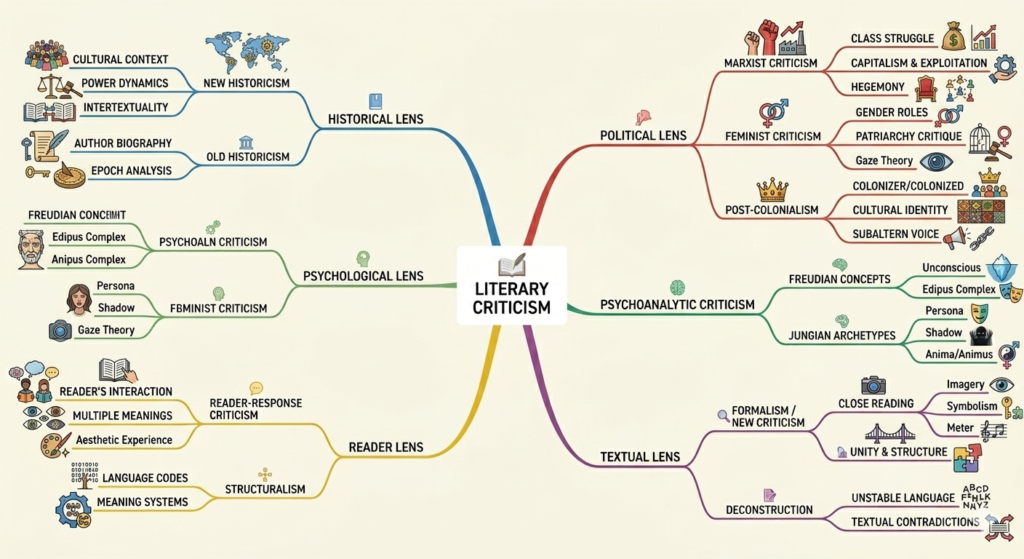
From a structural standpoint, literary criticism functions as an ongoing intellectual conversation that treats a text as a living cultural artifact rather than a static piece of writing. Academic frameworks often categorize these criticisms based on where they look for a story’s ultimate truth: within the words on the page themselves, within the mind and life of the author who wrote them, within the historical and political environment of the world at the time, or within the personal psychological reaction of the reader. Because no single book exists in a vacuum, every school of literary criticism chooses to prioritize one of these connections. Therefore, this turns literary criticism into a vital academic tool that shifts our focus from simply asking what a book is about, to investigating how a text actively constructs meaning, challenges societal power structures, and reflects the deeper anxieties of human culture.
Here is an breakdown of the 12 major schools of literary criticism, designed to give you a complete roadmap of how we analyze literature.
Text-Based Criticism: The Words on the Page:
These approaches view the text as a self-contained object. You do not need to know the author’s biography or the historical era to understand the work; everything you need is already in the writing.
- Formalism / New Criticism: Popularized in the mid-20th century, Formalism treats a text like a finely crafted clock. Critics ignore outside influences and focus strictly on “close reading”—analyzing how literary devices like irony, meter, paradox, and metaphor work together to create a unified theme.
- Deconstruction: Championed by Jacques Derrida, Deconstruction flips Formalism on its head. It assumes that language is inherently unstable and full of contradictions. Instead of looking for unity, a deconstructive reading looks for the gaps and cracks in a text to show how it ultimately undermines its own supposed meaning.
Author & Audience-Based Criticism: The Human Element:
These lenses shift the focus away from the text itself and look toward the human minds that created it or consume it.
- Biographical Criticism: This approach operates on the belief that a book is a direct product of its creator’s life. By studying an author’s personal letters, diaries, and life events, critics uncover deeper, often hidden meanings within their creative work.
- Psychoanalytic Criticism: Drawing heavily from Sigmund Freud and Carl Jung, this method analyzes the psychological state of the characters or the author. It hunts for repressed desires, defense mechanisms, Oedipal complexes, and the ways the unconscious mind manifests in the narrative.
- Reader-Response Criticism: This theory argues that a text is just ink on paper until a reader interacts with it. Because every reader brings their own baggage, memories, and cultural background to a book, the “meaning” of the text is actively created by the reader during the act of reading.
Cultural & Political Criticism: Power and Identity:
These frameworks look at literature as a battleground for social influence, examining how texts reinforce or challenge societal power structures.
- Marxist Criticism: Based on Karl Marx’s economic theories, this lens views literature through the prism of class struggle. It asks: Who has the money and power? Who is being exploited? How does the text reflect the capitalist or socio-economic realities of its world?
- Feminist Criticism: This lens examines how literature portrays women and reinforces or challenges patriarchal power. It critiques the historical sidelining of female authors and analyzes how gender roles are constructed, subverted, or policed within a story.
- Queer Theory: Emerging in the late 20th century, Queer Theory destabilizes traditional, rigid notions of gender and sexuality. It looks for “queer subtexts” in literature and breaks down the binaries of hetero- and homosexuality to explore the fluidity of identity.
- Post-Colonial Criticism: This approach analyzes literature produced by or about nations colonized by Western powers. It focuses on themes of cultural erasure, racism, identity confusion, and the ongoing psychological and political struggles of the formerly colonized.
- Critical Race Theory (CRT): CRT examines how literature and cultural narratives perpetuate systemic racism. It looks at how racial biases are embedded in language, character archetypes, and plot structures, aiming to uncover and challenge white-centric narratives.
Historical & Universal Criticism: Context and Myth:
These lenses zoom out to look at the broader sweep of human history and cross-cultural patterns.
- New Historicism: Unlike older historical criticism, New Historicism argues that literature and history are codependent. A text cannot be separated from the political, social, and cultural anxieties of the exact moment it was written. It treats literature as an active participant in history, rather than just a passive reflection of it.
- Archetypal / Mythological Criticism: Rooted in Jungian psychology, this lens looks for universal symbols, character types, and plot patterns (like the Hero’s Journey, the Flood, or the Fall from Grace) that transcend time and culture, tapping into what Jung called the human “collective unconscious”.
No single lens is the “correct” one. The richest literary analysis often happens when you stack these lenses together—for instance, looking at a novel through both a Feminist and a Marxist framework simultaneously see how gender and class intersect.