
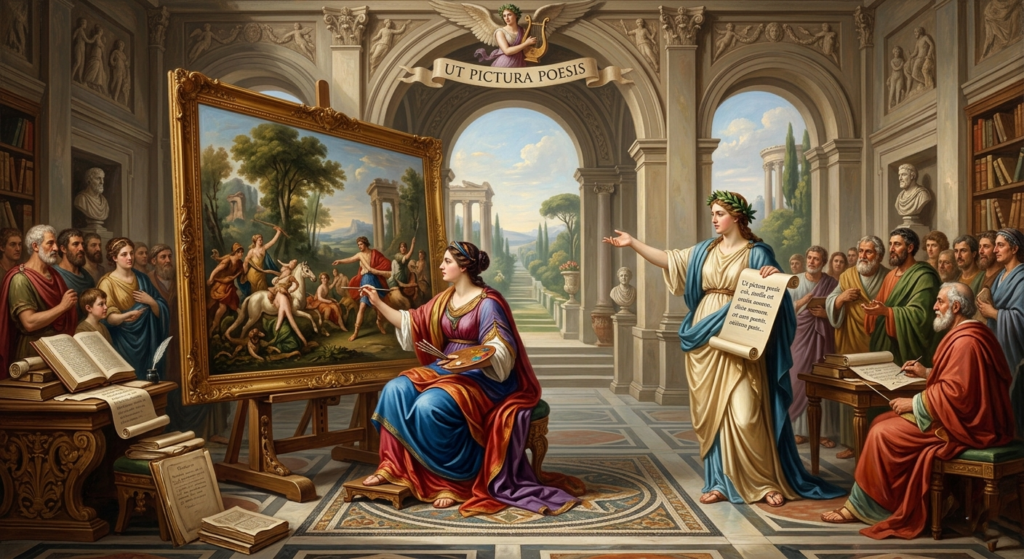

Poems are an expression as much as “painting” is an expression. Ut Pictura Poesis is a Latin phrase coined by the Roman poet Horace in his work Ars Poetica (c. 19 BCE). It translates literally to “as is painting, so is poetry.” Over the centuries, this phrase became the foundational philosophy for comparing the visual arts with the literary arts.The Core Meaning: At its heart, the concept suggests that poetry and painting share a common goal: to capture human experience, emotion, and nature, just through different mediums. Horace’s Original Context: Interestingly, Horace didn’t originally mean that painting and poetry are exactly the same. He was actually making a point about how art is judged. He noted that some paintings are meant to be looked at up close in the shade, while others require you to stand far back to appreciate the full view in the light. He argued that poetry is the same: some poems are light and enjoyable on a quick, casual read, while others require deep, close analysis to fully understand.
- Poetry as a Speaking Picture: A great poem uses words to paint vivid imagery in the reader’s mind, allowing them to “see” a scene.
- Painting as a Silent Poem: A great painting narrates a story, expresses a philosophy, or evokes a deep emotional response without uttering a single word.
Renaissance and Beyond: During the Renaissance and the Enlightenment, art critics and writers expanded Horace’s words into a massive cultural movement. They used Ut Pictura Poesis to argue that literature and visual art are sister disciplines that mirror one another.